
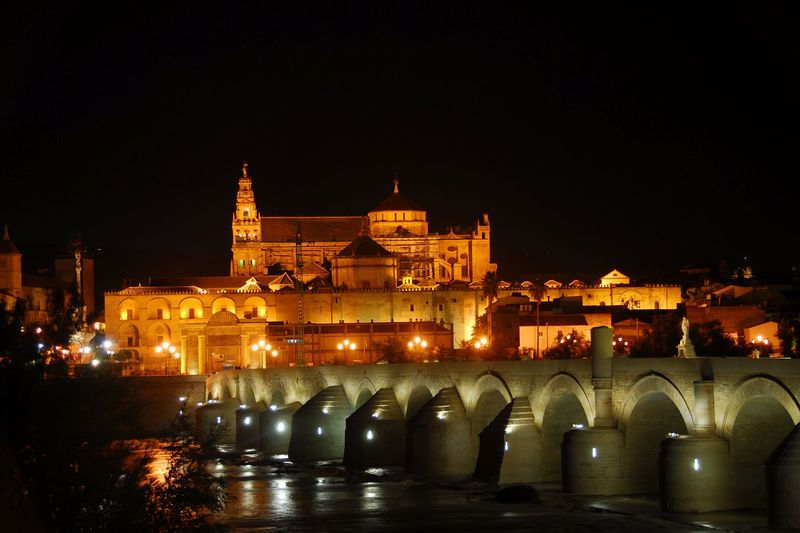
It was the capital of the Roman province of Hispania Ulterior Baetica (Baetica), an age of splendour in which it came to have as many entertainment buildings as Rome itself, and it gave Rome great philosophers such as Lucius Annaeus Seneca, orators such as Marcus Annaeus Seneca and poets such as Lucan. Later it held an important place in the province of Spania of the Byzantine Empire and during the Visigothic period. It became a capital once again under the Independent Emirate and the Umayyad Caliphate of the West, the period in which it reached its peak, with between 250,000 and 500,000 inhabitants; in the 10th century it was one of the largest cities in the world, as well as a great cultural, political and economic centre. One of its best-known monuments dates from this period: the Mosque of Córdoba.
Today it is a major cultural reference point in southern Europe and one of the most beautiful and best-preserved cities in Spain, with one of the highest qualities of life. It has one of the largest historic centres in the world, declared a UNESCO World Heritage Site in 1994 (the Mosque has been one since 1984), and the city also has several very modern, well-connected districts that represent the modern Córdoba of the 21st century.
The history of the monument is covered in History of the Mosque of Córdoba.
Roman Period
Little is known about the origins of the city of Córdoba. The earliest records date from the Late Bronze Age. There was an indigenous settlement called Corduba. From 206 BC, when the city was conquered by the Romans under the command of Lucius Marius, Córdoba became an important city, serving as a base for Roman troops. It was regarded as the unofficial capital of Hispania Ulterior.
It was with the civil wars between Caesar and Pompey that Córdoba fully entered the course of history. After Caesar's victory it suffered severe destruction and a significant fall in population, although it did not lose its earlier privileges. Córdoba was granted the status of colony, which made it the capital of the newly created province of Baetica following the administrative reforms undertaken by Augustus. During the first three centuries of the Roman Empire the city flourished thanks to the status that came with being a capital. There were schools of a high standard, and some citizens of Córdoba became senators in Rome. Córdoba was the centre from which the official post set out for the other cities and the seat of the administrative archives. Trade in oil, minerals and agricultural produce thrived, helped without doubt by the construction of the Via Augusta, which crossed the Roman bridge over the Guadalquivir and linked Linares with Cádiz and Baetica with the other settlements of Hispania. The most important figure of Hispano-Roman Córdoba was Seneca, even though he was taken as a child to the capital of the empire, where he became Nero's tutor.
Once the civil war was over, Córdoba was granted the status of colony, which made it the capital of the newly created province of Baetica. During the first three centuries of the Roman Empire the city flourished; it was the most prosperous city in Andalusia and had schools of a high standard. The construction of the Via Augusta, which crossed the Roman bridge over the Guadalquivir and linked Linares with Cádiz and Baetica with the other settlements of Hispania, also contributed to this. Córdoba was walled, as the archaeological remains show.
Visigothic Period
The decline began under Diocletian: the capital moved to Hispalis (Seville) and Christianity began to spread in the lands of Córdoba. Christian communities started to gain importance, as shown by the early Christian sarcophagi now kept in the Alcázar and in the Archaeological Museum.
In the 5th century there was a profound transformation. Córdoba was sacked by the Vandals, who gave their name to the region of Andalusia. Roman power gradually disappeared and a Visigothic dux settled in Baetica. For a time Córdoba suffered from the rivalries between factions fighting for power, such as the struggle between Leovigild and his son Hermenegild, which ended with the former's conquest of Córdoba. From then on, a ruling minority imposed itself on the Hispano-Roman majority.
During the reign of the Catholic King Reccared, the Visigoths built the Basilica of San Vicente over a Roman temple to the Sun, on the same site that the great congregational mosque would later occupy. Revolts by the nobility were constant, leading to the civil wars that preceded the Muslim invasion.
Muslim Period
In 711 Córdoba was conquered by the generals of the Arab invader Tariq. The invaders set up their seat of government in the Visigothic fortress, located near the present-day Alcázar of the Christian Monarchs, and appointed a wali, or governor.
Five years after the conquest, the Arabs made Córdoba the capital of the lands of Al-Andalus. The Roman bridge was rebuilt, the walls were restored and the suburb known as Secunda, today Campo de la Verdad, was founded on the left bank of the Guadalquivir. An early congregational mosque was founded in Córdoba when the Umayyads and the Abbasids finally split after a bloody struggle. In 756 the Umayyad prince Abd al-Rahman defeated the Abbasid emir and rose, now as Abd al-Rahman I, to become the sole authority in Andalusia. He promoted the building of the mosque in 786. His successors encouraged the development of culture, and mystics, Eastern masters, mathematicians, physicians, philosophers and poets settled in Córdoba. The mosque was completed and was later extended by Abd al-Rahman II.
Little by little Arab civilisation became consolidated. Muslim Córdoba reached its greatest splendour under Abd al-Rahman III. He took the title of Caliph in 929 and made Córdoba a caliphate independent of Damascus and the most prosperous, cultured and populous city in Europe. He extended the mosque again and gave it a courtyard with porticoes. 8 km from the capital he built the sumptuous palace of Medina Azahara. His son Al-Hakam II completed the palace works, extended the mosque once more and assembled a library of 400,000 volumes, the most important in the world. According to Arab sources, during his caliphate the city reached a million inhabitants and had sixteen hundred mosques, three hundred thousand houses, eighty thousand shops and countless public baths.
This splendour began to decline during the reign of his successor, who left the government in the hands of the military leader Almanzor, who carried out the last extension of the Mosque.
The Caliphate began to break up because of civil wars, which destroyed central power and led to the formation of the taifa kingdoms throughout Andalusia. The Berbers, aided by King Sancho of Castile, seized Medina Azahara in 1010, setting it on fire and plundering it. In the 11th and 12th centuries Córdoba was just one more taifa. It fell to Seville in the time of the poet king Al-Mu'tamid. Its last petty king, Ibn Hud, lost the city to Ferdinand III the Saint.
Among the many scholars and artists of caliphal Córdoba, special mention should be made of the poet Ibn Hazm (994-1064), the philosopher Averroes (1126-1198) and the Jewish physician and thinker Maimonides (1135-1204).
Christian Period
On 29 June 1236 Córdoba fell to King Ferdinand III. After the signing of the capitulations, the Muslim population was removed from the city. New churches began to be built in the style known as Fernandine or Reconquest style: a transition from monastic Romanesque to Castilian Gothic.
The city remained the centre of civil conflicts, which only subsided under the Catholic Monarchs.
16th to 20th Centuries
Although under the Habsburgs the Puerta del Puente and the Plaza de la Corredera were built and the Cortes of 1570 were held with Philip II, Córdoba gradually lost importance and population.
During the reign of Philip IV, in the following century, the bread riot took place because of a shortage of wheat.
In the 19th century Córdoba experienced a great surge of patriotic fervour during the War of Independence. In the following years Córdoba went through a period of tense disputes between absolutists and liberals. During the reign of Isabella II Córdoba was a stronghold of the liberals, who in 1868 defeated the royalists at the bridge of Alcolea.
In the mid-20th century the city changed its appearance, promoted its popular traditions and modernised.